Uptime SLAs in Mining Hosting: Reading the Fine Print
An uptime guarantee is only worth the margin it protects. At 1 PH/s on 20 J/TH machines, one percentage point of downtime costs about $0.36 of gross income a day and saves roughly $0.29 of electricity, so the real damage is a little over $0.08 a day — around $2.30 a month. Read the SLA as a margin contract rather than a headline percentage and the negotiating priorities change completely.
Key takeaways
- Put the guarantee in dollars: one point of uptime at 1 PH/s on 20 J/TH hardware is worth about $2.30 a month, while at 10 PH/s the same point is roughly $23.
- Check what is excluded before checking the number — scheduled maintenance, network faults and site power events are usually carved out of the calculation.
- Uptime is not hashrate. A rig running at 80% of its rated power for thermal reasons is "up" and still costing you a fifth of its income.
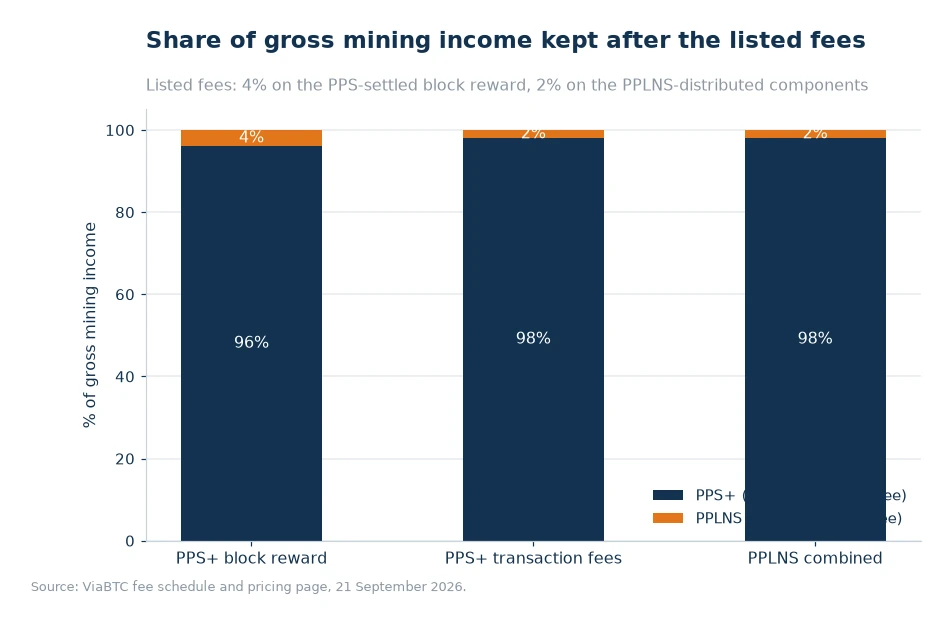
- A listed pool fee of 4% on the PPS-settled block-reward component applies only to payouts you actually earn, so downtime costs income rather than fees.
The core idea
Mining income arrives per share, so any hour without shares is an hour of income that never existed — it is not deferred and cannot be claimed back. That makes an uptime SLA a promise about a revenue stream, not about a machine. The useful way to price it is per percentage point, expressed in contribution margin: income per day minus power per day, multiplied by the fraction of time lost.
The counter-intuitive part is that downtime has a credit side. Machines that are offline do not draw power, so the true cost of a lost hour is the contribution margin for that hour, not the gross income. On efficient hardware the two are close enough that an honest SLA conversation is mostly about measurement. On inefficient hardware the difference is the whole point, and it can invert the sign.
| Hardware efficiency | Power per PH/s | Net income per day | Power per day | Cost of 1 point of downtime |
|---|---|---|---|---|
| 15 J/TH | 15 kW | $36.47 | $21.60 | $0.149 a day |
| 20 J/TH | 20 kW | $36.47 | $28.80 | $0.077 a day |
| 25 J/TH | 25 kW | $36.47 | $36.00 | $0.005 a day |
| 30 J/TH | 30 kW | $36.47 | $43.20 | minus $0.067 a day |
How it plays out at scale
At one PH/s the arguments above are academic; at ten PH/s they are a line item. Ten PH/s on 20 J/TH hardware draws about 200 kW, which is 4,800 kWh a day and roughly $288 of electricity at $0.06/kWh against $379.93 of gross mining income, or $364.74 after the listed 4% fee on the block-reward component. The contribution margin is therefore $76.74 a day, and one point of uptime is 77 cents a day — about $23 a month. Nine points, the difference between a 99% and a 90% guarantee, is roughly $210 a month on a single site.
That reframes the negotiation. A site charging a slightly higher power rate with a 99.5% guarantee measured on the machines themselves can be cheaper than a site with a 99% guarantee measured on the building, because the second site's guarantee does not cover the failure mode that actually costs money: rigs that are powered but not submitting shares.
There is also an efficiency trap hiding in a strict SLA. On 30 J/TH hardware the same PH/s loses $0.067 a day for every point of uptime it gains, because power saved during downtime exceeds income lost. A contract that guarantees uptime on hardware that cannot cover its own electricity is a contract to lose money reliably, which is why the decision order should be efficiency first, then uptime, then price per kWh.
The pool side of the equation is the part the operator actually controls. multi-coin mining pools let a hosted rig be re-pointed at a different chain without moving a cable, which is worth more than half a point of uptime in the months when one coin's margin turns and another's does not.
Two scenarios compared
Scenario A — the same site, two clauses. One PH/s at a site guaranteeing 99.5% machine-level availability with a remedy of hosting credits capped at 50% of a month's fee, versus the same hardware at a site guaranteeing 99% measured at the rack, with credits capped at 100%. Assume both sites have identical power prices and identical pool income. The expected income difference is 0.5 points of uptime, which is $0.38 a day on 1 PH/s at gross rates. The credit cap matters more than the percentage in months when downtime arrives in one large block rather than as background noise.
Scenario B — the fleet split across two sites. Ten PH/s split across two containers, each with 99% availability and independent power feeds, behaves better than 10 PH/s in one hall with a 99% guarantee, as long as the failures are not correlated. Correlated risk — a shared substation, a shared fibre route, a shared cooling loop — is what turns two 99% sites into one 98% system. Ask about upstream topology before signing, because the SLA percentage describes the site, not its dependencies.
Where a farm offers hosting alongside the mining account, the operational detail to confirm is how rigs are identified in the pool dashboard while they are on site. The ViaBTC Mining Farms route puts hosted machines under the same account structure as the rest, which means availability can be checked from per-worker hashrate rather than from a monthly report.
Common failure modes
- Building-level measurement. The site reports 99.9% because the hall had power; your units were throttled for eight hours and nobody counted it.
- Thermal derating in summer. Hashrate falls while availability stays perfect, and the SLA never mentions performance.
- Network, not power. A pool connection at 300 ms adds rejected shares; the machines are "up" and the income is lower.
- Spare parts lead time. A fan or a hashboard replacement measured in weeks is downtime even when the availability figure is technically unaffected.
- Exclusions doing the work. If planned maintenance is excluded and the site schedules it monthly, the effective guarantee is lower than the headline.
- Correlated utility risk. Substation or fibre maintenance outside the site's control, excluded from the calculation, hits every rig at once.
Two tools make those failures visible without an audit: per-worker hashrate history, and a live miner profitability ranking that tells you what each model should be earning at today's difficulty. Together they turn "the site was up" into a claim about output that can be checked against the pool.[1]
Frequently asked questions
What happens if my miner goes offline?
Shares stop, so expected income stops with them. Alerts and a dashboard that shows per-worker hashrate shorten the gap between a failure and a fix.
Is a bigger pool always better?
Size reduces payout variance but also concentrates hashrate. What matters more is fee structure, uptime, latency and payout cadence.
Does an SLA credit replace the income I lost?
Usually not in full. Credits typically offset part of a hosting fee, while mined income that never existed cannot be recovered — which is why machine-level measurement and short alert windows matter more than the percentage.
Do pool fees apply while a machine is offline?
No. The listed fee is a share of settled payouts, so a machine that submits no shares produces no payout and no fee. The cost of downtime is the income you did not earn.
Price the guarantee before you sign
Convert every SLA you are offered into dollars per point of uptime on your own hardware, and ask the site whether the measurement is per machine, per rack or per building. Then check the excluded list and the remedy cap, because those two clauses decide what the percentage is worth in the months when things break. Finally, confirm the pool-side view: if hosted rigs appear as named workers in your own dashboard, you will never have to take an availability claim on trust.
Data and sources: ViaBTC fee and payout documentation[1]. Network difficulty (132.76 T), network hashrate (1,003 EH/s) and the BTC price of $84,692 come from public chain data and market feeds read on 21 September 2026. All per-point cost and margin figures are own calculations from those inputs; hosting terms vary by operator and are not quoted here.