Reading an RTA Cabinet Product Page Like a Contractor
A cabinet page carries dozens of numbers and only a handful that change how the kitchen performs after installation. The most useful four sit in the construction block: the box panel is 1/2 inch, the face frame is 3/4 inch, the drawer box is 5/8 inch and the shelf is 3/4 inch. Read those first, then treat the discount badge as the last item on the page rather than the first.
Key takeaways
- A 1/2-inch birch plywood box, a 3/4-inch solid birch face frame, a 5/8-inch drawer box and a 3/4-inch shelf are the four gauges worth memorizing.
- Hinges are listed as soft-close, concealed and six-way adjustable; glides as soft-close undermount with full extension.
- Discount badges hide their base. Published list prices across the six starter kitchens run from $2,369.86 to $2,869.56, a spread of $499.70.
- Every base cabinet is 34-1/2 inches high and 24 inches deep, so widths from 9 to 42 inches are the only variable in a base run.
Four gauges before anything else
The construction block is where a contractor starts, because thickness is expensive to change and cheap to hide. CasaBuilt publishes a 1/2-inch birch plywood box with a natural birch interior and sides finished to match the door color. The face frame is 3/4 inch by 1-1/2 inch solid birch. Drawers are 5/8-inch dovetail, and shelves are 3/4-inch adjustable plywood, with a half-depth shelf in base cabinets.
Three of those numbers work as a set. The face frame stiffens the front of the box, the shelf carries the load inside it, and the drawer box takes the daily abuse. The 1/2-inch panel is the least glamorous of the four and does most of the work resisting racking when a loaded cabinet is dragged into place against a wall.
One inconsistency is worth flagging. A key-features block on the same product describes the dovetail drawers as birch, while the specification block lists rubberwood. Both cannot be right for the same part. A contractor reading the page would note it and ask support to confirm which applies to the cabinets being ordered, rather than assume the better-sounding version.
| Component | Published specification | Gauge |
|---|---|---|
| Box panel | 1/2-inch birch plywood, natural birch interior | 0.5 in |
| Face frame | 3/4-inch by 1-1/2-inch solid birch | 0.75 in |
| Drawer box | 5/8-inch dovetail, rubberwood in the spec block | 0.625 in |
| Shelf | 3/4-inch adjustable plywood, half-depth in base cabinets | 0.75 in |
| Hinge | Soft-close, concealed, six-way adjustable | 6-way |
| Glide | Soft-close undermount, full extension | Full |
| Finish | Paint layers with a UV protective topcoat | 7 coats |
Fields that decide how year five feels
Two hardware lines matter more than the door style, and both usually sit below the fold. Hinges are soft-close, concealed and six-way adjustable. Six-way adjustment lets a door move on three axes without new screw holes, which is the difference between a run of doors that lines up and a run with a shim behind every hinge. Glides are soft-close undermount with full extension, so a drawer opens far enough to reach the back corner.
The finish is listed as seven layers of paint with a UV protective topcoat. Seven coats is a slow process, and the UV layer is the part that matters beside a south-facing window, where an unprotected white door gradually shifts. The drawer box is dovetailed rather than stapled, a joinery detail you can check on a sample door before committing to a kitchen.
Adjustable shelves are 3/4-inch plywood, and base cabinets get a half-depth shelf. That last detail is small but consequential: a full-depth shelf in a base cabinet collides with the plumbing and the drawer stack behind it, so the page is telling you the shelf was designed for the box it sits in.
Where the marketing starts
The price block is the least reliable part of the page and the easiest to decode. CasaBuilt shows a sale price, a struck-through list price and a discount percentage. The percentage always refers to the list price, so a 50% badge on a $2,399.00 list produces the $1,199.50 sale price on White Shaker, while a 20% badge on a $2,869.56 list produces $2,295.64 on the oak line. The badge says nothing about which cabinet is better value; it says how far that line has been marked down.
Compare list prices for a like-for-like read. Across the six starter kitchens the list runs from $2,369.86 for Hudson Grey to $2,869.56 for the oak line, a $499.70 spread. Sale prices spread far wider, from $1,184.93 to $2,295.64, because the discounts differ. A buyer who reads only the badge sees a bargain; a buyer who reads the list sees the shelf the bargain came off.
Words to skim past include premium, designer and exclusive, none of which is defined on the page. Words to stop on carry a number: gauge, coat count, adjustment axes, extension length, warranty term. A claim without a unit is decoration.
The five-minute read
Order the check like this: construction block, dimension table, hardware lines, price block, sample page. Dimensions come second because they eliminate options fastest. Base cabinets are 34-1/2 inches high and 24 inches deep in every width from 9 to 42 inches, wall cabinets are 12 inches deep in 30, 36 and 42-inch heights, and vanities are 21 inches deep. If a width you need is missing, no finish quality rescues the run. The other half of that job is the room itself, and CasaBuilt publishes a measurement guide for taking wall lengths the way an installer needs them.
Then confirm what the headline price includes. CasaBuilt's starter bundle is two base, two wall, one tall and one vanity cabinet, while at least one listing describes three base and three wall instead. The same number can describe a different box count, so check the contents before comparing totals. A catalog built for rta cabinets online is usually clearer about components than about finishes, and this collection follows that pattern: the part list is on the page, the finish is a photograph.
Finish with the sample. Sixteen door samples are in stock, the standard ones at $9.99 with the fee refundable on a cabinet purchase, split into eight Shaker, three Double Shaker, three Slim Shaker and two Frameless profiles. A sample answers the two questions a screen cannot: how the color sits in your light, and how the door feels in the hand.
Worked example: the thickness ladder
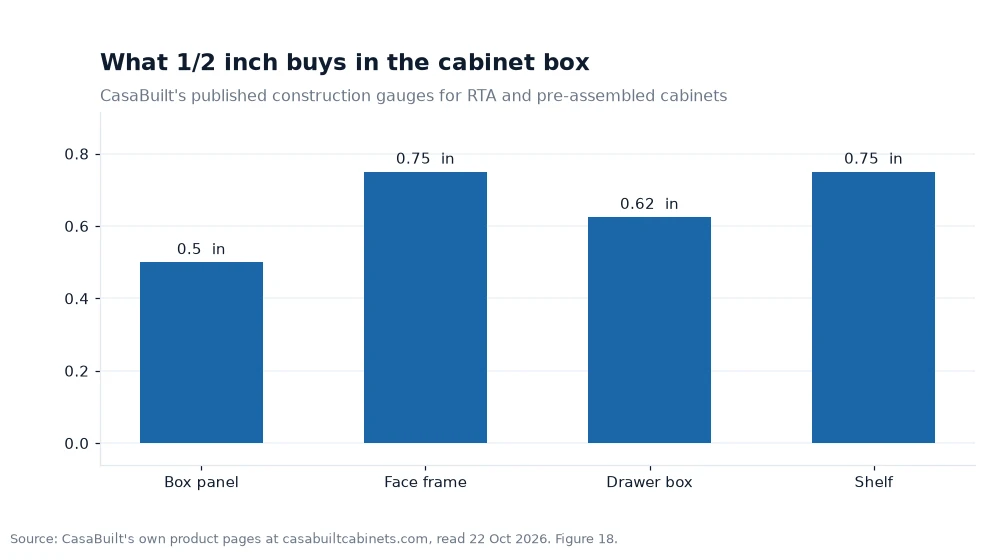
The chart plots four published gauges: box panel 0.5 inch, face frame 0.75 inch, drawer box 0.625 inch and shelf 0.75 inch. Convert each to eighths of an inch. The box panel is 4/8, the drawer box is 5/8, and the face frame and shelf are both 6/8.
Now the differences. Face frame minus box panel is 0.75 − 0.5 = 0.25 inch, two eighths thicker, and 0.25 ÷ 0.5 = 0.5 means the frame is 50% thicker than the panel it attaches to. Drawer box minus box panel is 0.625 − 0.5 = 0.125 inch, one eighth, or 25% thicker. Shelf minus drawer box is 0.75 − 0.625 = 0.125 inch, the same one-eighth step.
That produces a ranking without a single adjective: shelf and face frame at 0.75 inch, drawer box at 0.625, box panel at 0.5. The parts that take a load or hold a hinge are the thickest, and the panel that mostly closes the box is the thinnest. A page that publishes fewer than four of these figures is asking you to trust a word instead of a measurement.
Frequently asked questions
Is a 1/2-inch box panel thin for a kitchen cabinet?
It is the published figure for this range, paired with a 3/4-inch face frame and 3/4-inch shelves. Panel thickness is one input among several: the face frame stiffens the front, the shelves carry the load, and the drawer box takes the daily wear. Compare the same four gauges across two quotes rather than judging a single number in isolation.
What does a six-way adjustable hinge let me do?
It lets a door move on three axes without drilling new holes, so a run of doors can be leveled and gapped after installation. CasaBuilt lists soft-close concealed hinges with six-way adjustment, and soft-close undermount glides with full extension on the drawers.
Why is the discount percentage a poor way to compare styles?
Because each percentage is calculated from a different list price. A 50% badge on the $2,399.00 White Shaker list produces $1,199.50, while a 20% badge on the $2,869.56 oak list produces $2,295.64. Reading the list prices puts every style on the same footing.
Read the page in the order a fitter would
Print the construction block and the dimension table, then measure the room against them before you look at a photograph. Decide the widths first, because a 42-inch base and a 30-inch base are not interchangeable in a run, even when they cost the same. Order two or three samples and keep them for a week in the actual light of the kitchen. Finally, compare quotes on the same cabinet list, the same gauges and the same hardware, because that is the only comparison a discount badge cannot distort.
Figures quoted here come from the manufacturer's own website, read 22 Oct 2026[1].