Formula ownership and exclusivity are commercial terms, not production details, and they should be settled in writing before the first sample is paid for. A brand that can answer three questions — who holds the formula file, what the exclusivity clause actually covers, and what happens to the mould and the artwork if the relationship ends — has already avoided the most expensive category of dispute in a launch. Everything else in supplier selection can be repaired later; these three cannot be repaired cheaply.
Key takeaways
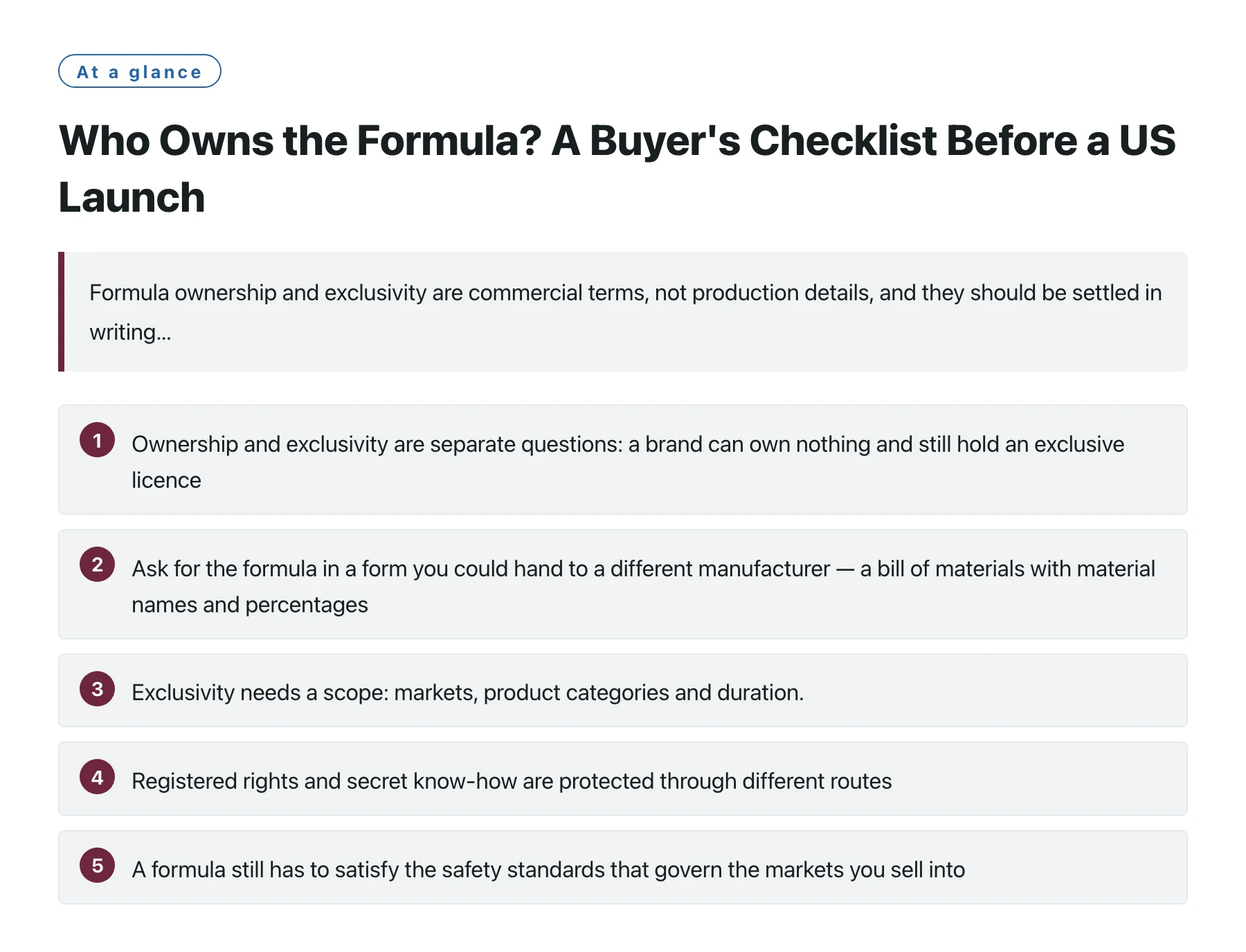
- Ownership and exclusivity are separate questions: a brand can own nothing and still hold an exclusive licence, or own the formula and still share the same base with other clients unless the contract says otherwise.
- Ask for the formula in a form you could hand to a different manufacturer — a bill of materials with material names and percentages, not a product code and a shrug.
- Exclusivity needs a scope: markets, product categories and duration. "Exclusive" with no territory attached is not a term, it is a mood.
- Registered rights and secret know-how are protected through different routes, and the international design and trademark systems administered by WIPO are only useful if the brand, not the supplier, is the holder [1].
- A formula still has to satisfy the safety standards that govern the markets you sell into; owning it does not exempt it from a material restriction [2].
Most first-time buyers treat the formula question as something that gets sorted out at the end of the project, once the scent is approved and the packaging is chosen. In practice the opposite is true. Ownership is decided by whoever wrote the paperwork at the start, and by the time a launch calendar is running, neither side has much appetite for reopening it.
The reason this matters more in the United States than founders expect is that a fragrance is rarely protected by a patent. It is protected by secrecy, by contract, and sometimes by a registered design on the bottle. Each of those three needs a different piece of paper, and all three decay quickly if nobody asks for them while the relationship is still friendly.
What follows is the checklist worth completing before a deposit, a tooling order or a launch date is committed.
Three questions that decide everything downstream
Start with the file itself. Ask the manufacturer to describe, in writing, what document set exists for your product at the end of development: the concentrate formula, the bill of materials, the filling specification, the artwork files and any test reports. Then ask who is named as the holder. A supplier that answers this precisely is usually well organised; one that answers with a verbal assurance is telling you something important about how the rest of the project will be documented.
The second question is about exclusivity, and it needs to be asked in a form that can be answered with a yes or a no. Is the base I am paying to develop available to another client? If the answer is yes by default, then what you are buying is a scent your competitors can also buy, which may be perfectly acceptable — it just needs to be a decision rather than a surprise.
Who holds the formula file
There are three common arrangements: the brand owns the formula outright, the manufacturer owns it and grants the brand an exclusive licence, or the manufacturer owns it and licenses it non-exclusively. All three are workable. The one that causes trouble is the arrangement nobody wrote down, because the default assumption on each side is usually different. A supplier that describes its own scope publicly — Xuelei's manufacturing arm is one example — tends to answer this quickly, because the same question comes up in every negotiation.
What exclusivity actually buys
Exclusivity is a bundle, not a switch. A complete clause names the ingredient or accord that is protected, the product categories covered, the territories, the duration and what happens on termination. It is entirely normal to buy exclusivity for a fine fragrance line in North America for three years rather than for every category worldwide in perpetuity, and asking for the narrower version often costs far less than founders assume.
Two details are worth insisting on. First, exclusivity should survive a change of supplier: if the clause dies when you leave, you never really had it. Second, it should cover the accord rather than the finished product name, because a competitor can rename a product overnight.
The ownership checklist
| Item | What to ask for | What a usable answer looks like |
|---|---|---|
| Concentrate formula | A bill of materials with material names and percentages | A document you could hand to a second manufacturer and get the same scent |
| Exclusivity | Scope: accord, categories, territories, duration | A clause that survives termination and names the accord, not just the product |
| Bottle mould and decoration | Who owns the tooling, and what it costs to move it | A named owner plus a written buy-out figure |
| Artwork and label files | Editable source files and the right to reuse them | Layered files held by the brand, not only a flattened PDF |
| Test reports | Stability, compatibility and safety documentation | Reports addressed to the product, with the batch referenced |
| Termination | What transfers, in what format, and within how many days | A defined handover period and file format written into the agreement |
Work down the table rather than across it. The last row is the one that determines whether the first five are worth anything.
Protect what can be registered, and accept what cannot
A scent composition is difficult to protect as a patent in most jurisdictions, and most houses do not try. The practical protection is secrecy plus contract, and the enforceable add-ons are the registrable ones: a trademark on the name, and an industrial design or design patent on a distinctive bottle. The international registration routes for those rights sit with WIPO, which publishes the filing systems and their member lists in one place [1]. The point of registering is not prestige; it is that a registered right names a holder, and the holder should be the brand.
This is where Xuelei Perfumes is a useful reference point when you are comparing suppliers, not because any particular company is the right answer, but because a manufacturer that publishes its service scope and its certification list gives you something concrete to check against. The same logic applies to ownership: a supplier that is comfortable putting the formula file, the exclusivity scope and the tooling ownership in one document is usually comfortable being audited in other ways too.
Before you pay a development fee, ask for the ownership and exclusivity terms as a single page you can keep. If the answer is "that comes later in the contract", the terms have not been decided yet — and the party who writes them later is the party with more leverage at that moment.
What a US launch adds to the list
Entering the US market changes the compliance paperwork more than the ownership paperwork, but the two intersect. Label rules, state-level disclosure initiatives and retailer requirements all mean the brand needs to be able to describe what is in the product to a regulator or a buyer without depending on the factory to answer an email within a week. That ability comes from holding the bill of materials yourself.
It also changes how you should read a safety document. A fragrance is checked against the standards maintained by the International Fragrance Association, which restrict or prohibit specific materials depending on the product category and the concentration used [2]. Those restrictions apply to the formula regardless of who owns it, so an ownership clause that freezes the formula also freezes your ability to reformulate quickly if a restriction changes. Build a reformulation right into the agreement at the same time.
None of this requires a difficult conversation. It requires a short one, held early, with a list. Brands that run due diligence on a perfume manufacturer before signing tend to find that the ownership discussion is the cheapest part of the whole project to resolve.
Sources
- WIPO — World Intellectual Property Organization —— The UN agency for intellectual property; resources on industrial design and patent protection relevant to product and packaging design.
- IFRA Standards Library (International Fragrance Association) —— The IFRA Standards Library lists the restrictions the fragrance industry applies to individual fragrance ingredients, based on safety assessments; it is the reference point for compliant fragrance formulation.
Frequently asked questions
Can a brand own a fragrance formula without owning the concentrate recipe?
Strictly, no. Ownership of the formula means holding the document that lists the materials and their proportions. A brand can control the commercial use of a scent through an exclusive licence without holding that document, but it cannot reproduce the product elsewhere, which is the practical test most buyers care about.
Is exclusivity worth paying for on a first order?
It depends on whether the scent is the reason customers will buy. If the brand's advantage is distribution, price or design, a non-exclusive base at a lower development cost is often the better trade. If the scent is the product, paying for a defined exclusive scope is usually cheaper than rebuilding the fragrance later.
What should happen to the bottle mould if we change manufacturers?
The agreement should name who owns the tooling and state a buy-out figure or a transfer procedure. Without that, the mould is a hostage: you can leave, but you leave without your bottle, and retooling is one of the slowest and most expensive parts of a relaunch.
Does owning the formula mean the manufacturer cannot use the same accord for anyone else?
Not automatically. If the manufacturer developed the base from its own library and the contract is silent, the default position is usually that the base remains available to other clients. Exclusivity has to be granted explicitly and paid for.
How specific should the exclusivity clause be?
Specific enough that a lawyer could decide whether it has been breached. Name the accord or ingredient set, the product categories, the territories and the duration, and state what happens on termination. A clause that says the scent is exclusive to the brand, with nothing else attached, is difficult to enforce.