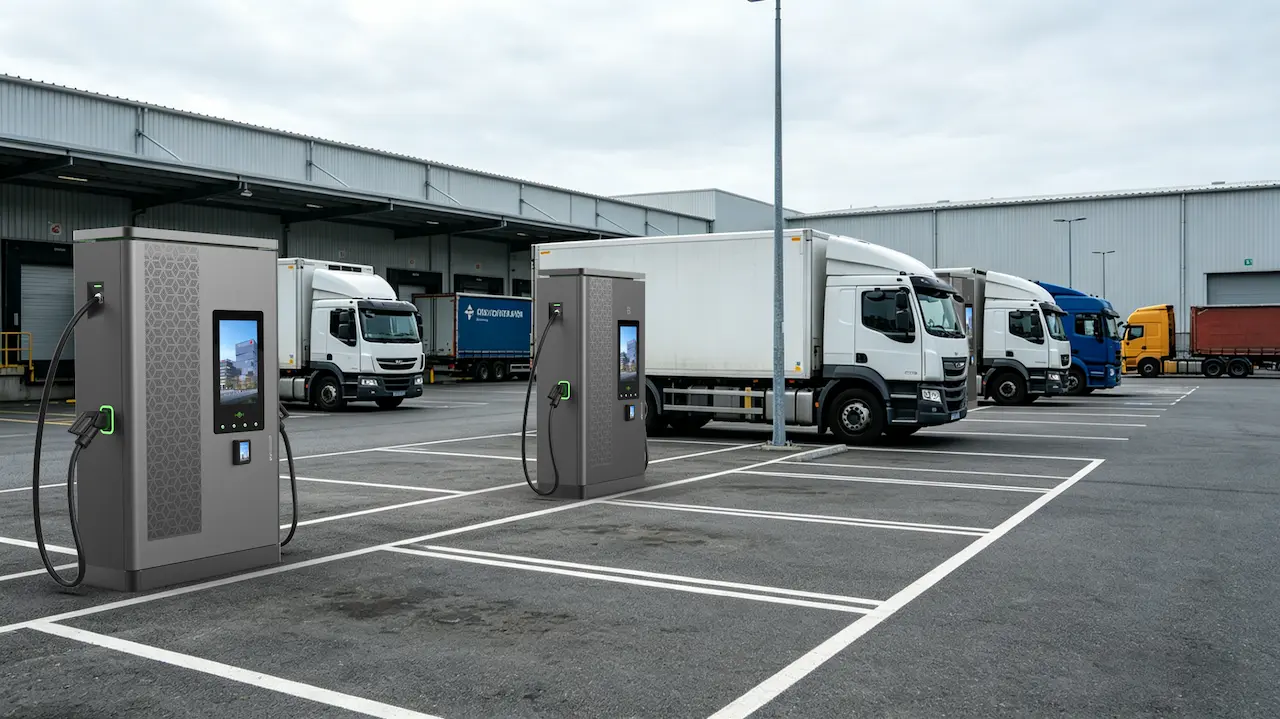
AC and DC charging should be selected around vehicle capability and available parking time. Alternating-current charging is often suitable for vehicles that remain parked for hours. Direct-current charging becomes useful when the fleet needs substantial energy within a shorter window, or when the vehicle's AC charging capability cannot meet its route requirement.
Neither option is automatically the right answer for an entire depot. A mixed fleet can use slower charging for predictable overnight work and reserve faster equipment for demanding routes, short turnarounds or operational recovery.
Check the vehicle before the charger rating
With AC charging, the vehicle's onboard charger converts incoming AC electricity into the DC electricity used by the battery. Its rating can limit the charging speed even when the charging point is capable of supplying more power. The site's voltage, phase arrangement and the vehicle's supported connection also matter.
A 22 kW AC charging point, for example, will not charge a vehicle at 22 kW if that vehicle can accept only 11 kW AC. Buying the larger charging point may still support future vehicles, but that future benefit should be distinguished from the performance of the current fleet.
DC equipment supplies DC power to the vehicle's charging system, bypassing the onboard AC charger. The vehicle still controls what it can accept. Battery temperature, state of charge, voltage range and the charging curve affect the power delivered during a session. A charger's maximum rating does not establish a universal charging time.
Use the energy deficit to compare the options
Suppose a vehicle needs 44 kWh added before its next route. At an average battery charging power of 11 kW, the simplified energy calculation gives four hours. At an average of 50 kW, it gives about 53 minutes. These are illustrative calculations, not predictions for a particular charger or vehicle.
The comparison is meaningful only if the assumed average power is achievable over the required part of the charging session. For AC, conversion losses and auxiliary consumption can make battery charging power lower than the equipment's input rating. For DC, tapering at higher states of charge may extend the session.
Use measured charging data or the vehicle manufacturer's information to replace the assumptions. If the fleet routinely has nine hours available, four-hour charging may be entirely adequate. If vehicles have an hour between routes, a faster arrangement deserves closer assessment.
Account for the electrical and operational cost
The hardware price is only part of the comparison. Check installation work, electrical capacity, maintenance responsibilities, software charges and the electricity tariff. A high-power charger may increase the project's grid requirements even if it is used infrequently.
Also consider how vehicles will share equipment. One fast charger serving several vehicles requires a process for moving them between bays. Without staff available to do that, the theoretical throughput will not be achieved. Dedicated overnight points can reduce vehicle movements, provided their charging capacity is sufficient.
A useful mixed layout may allocate AC points to vehicles with long dwell times and DC points to a smaller group with tighter schedules. The fleet charging solutions from EVB can be used as a supplier reference when discussing this combination. The proposed equipment should still be matched to the actual vehicles, connector requirements and site supply.
Examine shared power carefully
Equipment with two connectors does not always deliver its maximum advertised power to both vehicles simultaneously. Some designs share a total power allocation, and performance may change with the connected vehicles' voltage or demand.
Ask the supplier for the output available at each connector when both are in use. For a larger power-sharing system, request the allocation rules and the limits at the cabinet, dispenser and site levels. Those details determine whether two vehicles can meet their departure deadlines together.
The same principle applies to AC load management. Several charging points may be installed, but their combined operation depends on the available site power and the minimum current accepted by the connected vehicles.
Keep a recovery plan without oversizing every bay
A depot should decide how to handle an unexpectedly low battery or a delayed return. That may involve a dedicated recovery charger, revised dispatch, a spare vehicle or an approved external charging arrangement. The answer depends on the cost of a missed departure and the frequency of exceptional days.
During commissioning, test the actual mix of vehicles together. Confirm charging access, usable cable reach, scheduled power sharing and the time needed to complete representative sessions. Evaluate driver movements as well as electrical performance.
The right AC and DC mix is the one that supplies the required energy within the working schedule at an acceptable total cost. The decision should remain understandable when the fleet manager explains it to finance, facilities and dispatch.