Aeration Problems and How Piping Design Prevents Them
Oxygen is useful before fermentation and damaging after it, and the switch happens somewhere in your pipework. HGMC publishes piping designed to avoid wort aeration as one of the advantages of its brewing vessels, which is a design decision rather than a maintenance task.
Key takeaways
- Hot wort tolerates oxygen because the boil drives volatiles off; cooled wort does not, so the transfer line is the critical stretch.
- Piping that falls towards the outlet, avoids rising legs and keeps pump suctions flooded is how a system limits oxygen pickup.
- HGMC publishes piping designed to avoid wort aeration, with automatic mash, wort and water flow and temperature control on the higher control levels.
- One milligram of oxygen per litre in a 1,170 L batch is 1.17 grams of oxygen dissolved into your beer.
Where oxygen gets in and where it does the damage
Oxygen dissolves into wort wherever the liquid meets air with energy behind it. A splash, a vortex in an open tank, a pump pulling air through a leaking gasket and a cascade into a fermenter are all ways to add it. On the hot side of the brewhouse this is tolerable, because the boil continues afterwards and drives off much of what was absorbed, and because yeast needs oxygen to build healthy cell walls at the start of fermentation.
The cold side is a different story. Once the wort is cooled on its way out of the heat exchanger, any oxygen it collects is carried into the fermenter and stays in the finished beer, where it goes to work on hop aroma and malt character during storage. That is why the pipe run from the cooler to the fermenter, and later the run from the bright tank to the filler, receives most of the attention in a well-designed brewery.
The mechanics, without the chemistry
Three simple behaviours explain most aeration faults. First, liquid falling through air takes oxygen with it, and the more freely it falls, the more it takes. Second, air pockets held in the top of a rising pipe or an oversized line let a thin film of beer meet a bubble for as long as the pipe is in use. Third, a pump that is fed poorly, or run against a partly closed valve, draws more air out of solution or pulls it in past a seal.
Good piping design works on all three at once. Runs fall in the direction of flow so the pipe stays full, mains are sized for a reasonable velocity rather than generously oversize, suction lines are short and flooded, and any tee that takes flow off the main leaves from the top or the side rather than from below, where it would trap gas.
Design rules a buyer can check on the drawing
| Design rule | What it prevents | Check on the drawing |
|---|---|---|
| Continuous fall towards the outlet | Air trapped at a high point of the line | Every run has a stated direction of fall |
| Short, flooded pump suction | Cavitation and air drawn in through a seal | Suction line is below tank outlet level |
| Sized rather than oversized mains | Slow flow that leaves a surface film exposed | Line size is matched to the pump duty |
| No cascades into open vessels | Falling beer picking up oxygen from the air | Inlet enters low, below the liquid surface |
| Drains at low points | Standing beer in a rising leg going stale | Every low point has a drain or a valve |
The last rule is the one that protects flavour between brews rather than during them. Beer left in a rising leg overnight is beer that will be pushed into the next batch, and it is a fault that shows up intermittently, which makes it expensive to find after the fact.
Valves, gaskets and dead legs
Hardware decides how well the drawing is realised. Butterfly valves are compact and cheap in pipework terms, but their disc sits in the flow path and their seat allows a small amount of liquid to be trapped against the seal. Diaphragm valves cost more and clean better, which is why they are common on the cold side of breweries that care about shelf life.
Gaskets are the quiet culprit. A gasket that sits slightly proud of the flange creates a lip where air is drawn in on the suction side of a pump, and the leak is often too small to drip. Dead legs are the mirror image on the pressure side: a branch that is never flushed holds beer, and that beer is a source of both oxygen and microbial risk. A short check of every branch during commissioning, with the line open and the pump running, finds most of these before the first brew.
Worked example: the oxygen budget and the cost beside it
Start with the oxygen arithmetic and state the assumptions: a 1,170 L batch, which is 10 BBL at roughly 117 L per barrel, and a target of no more than 0.5 mg of oxygen per litre picked up between the cooler and the fermenter. Half a milligram per litre across 1,170 L is 585 mg, or about 0.59 g of oxygen in the whole batch. Compare that with what a single free-falling transfer can add: one extra milligram per litre in the same batch is 1,170 mg, or 1.17 g.
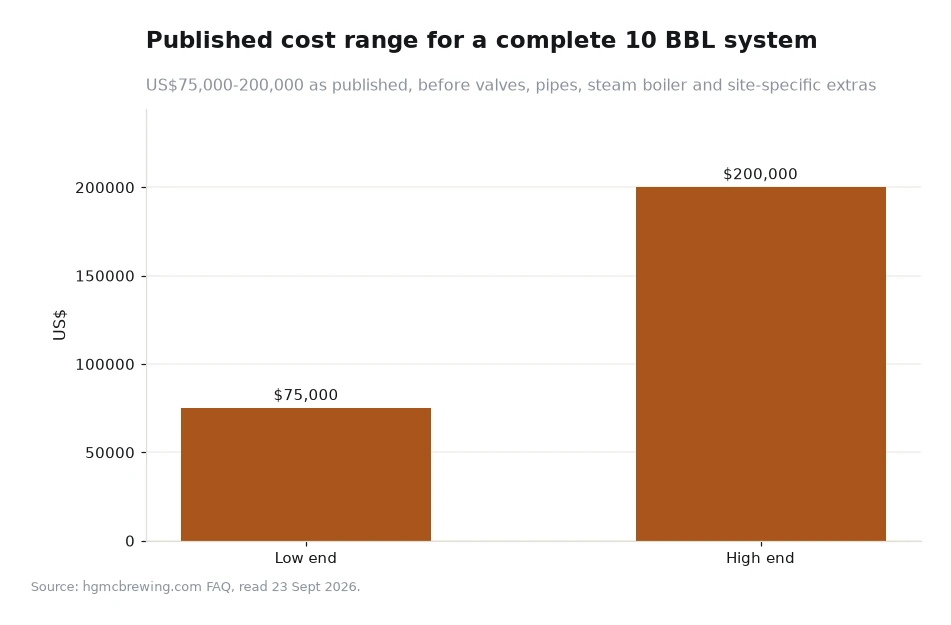
The chart on this page is the published cost range for a complete 10 BBL system, US$75,000 to US$200,000, before valves, pipes, a steam boiler and other requirements. Divide the low end by 11.7 hectolitres of batch capacity and the figure is about US$6,410 per hectolitre; the high end gives about US$17,094 per hectolitre. Those numbers describe the equipment, not the beer, but they explain why a buyer should spend a little of the budget on the pipe run rather than all of it on tank size: the transfer line is a small line item with a large effect on how long the beer lasts.
Frequently asked questions
How does piping design reduce oxygen pickup?
By keeping the wort in a full, smooth column: runs that fall towards the outlet, no rising legs where beer can stand, flooded pump suctions and no low branches that hold liquid. HGMC publishes piping designed to avoid wort aeration, which puts the fix in the steel rather than in a procedure the night shift has to remember.
Which side of the brewery is more sensitive to oxygen?
The cold side. Hot wort can tolerate contact with air because the boil continues afterwards, but once the wort is cooled and fermentation begins, oxygen picked up between the heat exchanger and the fermenter stays in the beer, where it shortens shelf life and flattens hop aroma.
What to do before the pipework is fabricated
Ask for the piping route at the same time as the tank drawings, and mark the direction of fall on it yourself with a pencil. Walk the route on site with the installers and confirm that the suction lines can be flooded, that no branch will hold beer, and that every low point can be drained. The brewery system pages show how the vessels and their connections are grouped, and the brewhouse equipment pages cover the hot-side arrangements these runs connect, and the manufacturer's Brewing Equipment listing maps everything that sits either side of them.
Then keep the habit after commissioning. Check the sight glasses for bubbles, listen to the pump rather than the room, and treat any gasket that weeps on suction as urgent. Those three practices cost nothing and they protect the same beer that the design was meant to protect. Buyers comparing micro scale packages can raise the piping question early, because it is far easier to draw a falling run than to re-pipe a working brewery.
The piping and aeration points, control levels and the 10 BBL cost range quoted here come from the manufacturer's own website, read 23 Sept 2026; the oxygen figures and per-hectolitre costs are our own labelled arithmetic. [1]